
EGWP PDPs: Everything Employers Need to Know
Who, What, Where, When, & Why
As retiree healthcare costs continue to rise and Medicare regulations evolve, many plan sponsors (employers) are looking to save money and get clarity for their retirees. For organizations currently administering Retiree Drug Subsidy (RDS) plans or considering changes to their post-65 retiree strategy, Employer Group Waiver Plan (EGWP) Prescription Drug Plans (PDP) are becoming an increasingly attractive option.
EGWP PDPs offer employers the ability to maintain robust retiree benefits while improving cost management, reducing administrative burden, and accessing additional savings opportunities through Medicare Part D. Below are six of the most frequently asked questions we receive from brokers and consultants when evaluating an EGWP PDP strategy.
What Is an EGWP PDP vs. RDS vs. MA-PD?
EGWP PDPs are an employer-sponsored Medicare Part D prescription drug plan designed specifically for Medicare-eligible retirees and their spouses. Administered by a Pharmacy Benefit Manager (PBM) like Pharmacy Benefit Dimensions, EGWPs allow employers to maintain comprehensive retiree drug coverage while leveraging Medicare subsidies and enhanced rebate opportunities.
Compared to RDS or MA-PD models, EGWPs provide:
- Greater plan customization
- Enhanced cost-management opportunities
- PBM-led CMS compliance and reporting
- Continued benefit continuity for retirees
While RDS programs allow employers to receive subsidies for maintaining retiree drug coverage, EGWPs often provide greater flexibility and additional savings opportunities. MA-PD plans bundle medical and pharmacy coverage together but typically offer less customization and employer control than an EGWP PDP arrangement.
How Much Can a Plan Save by Moving to an EGWP?
One of the primary reasons employers transition to EGWP PDPs is the opportunity for meaningful cost savings while maintaining strong retiree benefits.
Savings opportunities may include:
- Federal CMS subsidies
- Manufacturer discount programs
- Enhanced rebate opportunities through plan design optimization
- Preferred drug strategies for clinically equivalent, lower-cost alternatives
- Customized formularies
- Medication Therapy Management (MTM)
Combined these opportunities drive to a series of levers for each plan to utilize to drive costs down.
Who Handles CMS Filings, Audits, and Documentation?
Unlike RDS programs, EGWP PDPs are managed directly through the PBM. The PBM owns the EGWP Part D contract and serves as the primary interface with CMS on behalf of the plan sponsor making it a hands-on or hands-off experience, based on plan preference.
This includes responsibility for:
- CMS filings and reporting
- Ongoing compliance management
- Audit preparation and support
- Formulary updates
- Regulatory monitoring
This structure significantly reduces administrative burden for employers while ensuring compliance with evolving CMS regulations. As healthcare regulations continue to evolve through initiatives like the Inflation Reduction Act (IRA) and Maximum Fair Price (MFP) provisions, having a proactive PBM partner becomes increasingly important. Look to an experienced PBM to monitor CMS guidance, update formularies, and implement strategies that help plans remain compliant while maximizing savings opportunities.
When and How Does EGWP Implementation Take Place?
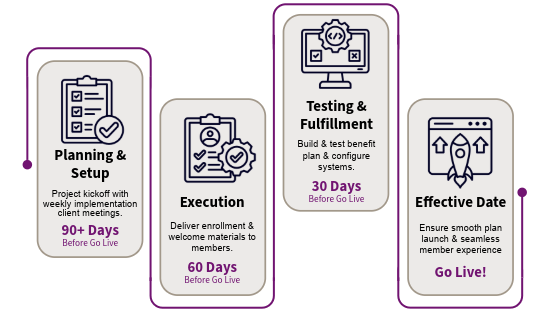
Implementing an EGWP PDP follows a similar process to implementing a self-funded pharmacy plan, but with additional CMS compliance requirements and Medicare coordination.
Implementation generally includes:
- Strategic planning and onboarding
- Benefit and formulary configuration
- Member communication development
- Open enrollment support
- CMS compliance review
- Go-live monitoring
Depending on the complexity of the plan, implementation may take anywhere from 3–6 months. Organizations transitioning from an existing EGWP PDP arrangement may experience a shorter timeline.
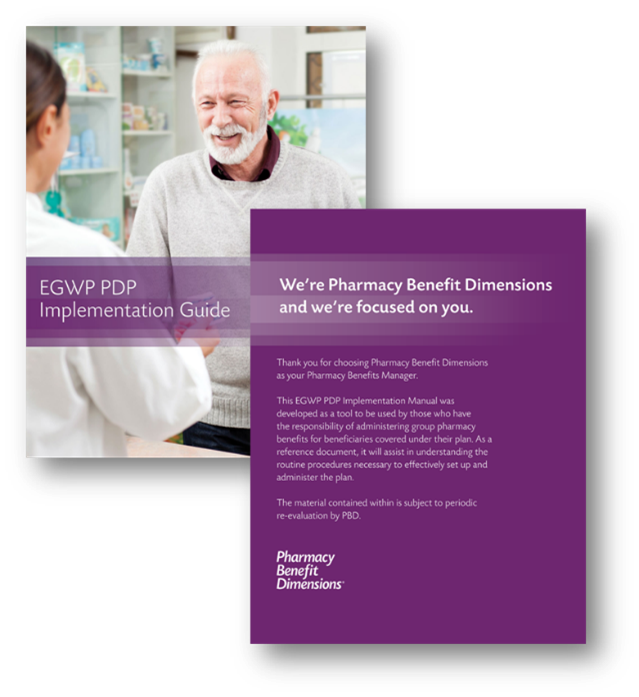
Education is also a critical component of successful implementation. PBDRx provides an implementation step-by-step guide for plan sponsors for those unfamiliar with EGWP PDP structures. Leading with proactive communication and onboarding support help minimize disruption and improve the member experience during transition.
Where Does an EGWP Fit in Your Retiree Strategy?
EGWP PDPs are especially valuable for organizations seeking to preserve retiree benefits while improving long-term affordability and sustainability.Organizations that commonly benefit include:
- School districts
- Municipalities
- Union and union trust plans
- Healthcare systems
- Employers currently participating in RDS programs
These organizations often provide rich retiree benefits and are looking for ways to better manage long-term costs without eliminating coverage altogether.
Pharmacy Benefit Dimensions has administered MA-PD plans since 2006 and EGWP PDPs since 2015, supporting school districts, municipalities, healthcare systems, union plans, and more. With multiple CMS contracts, strong audit performance, and proven implementation experience, PBDRx helps employers navigate the complexities of retiree pharmacy benefits while maximizing value for both plans and members.
Why Are Employers Making the Shift?
The EGWP market continues to grow as employers search for more sustainable retiree pharmacy benefit strategies. EGWP PDPs are becoming increasingly popular with a $20B addressable market and 6.3M beneficiaries enrolled in 2026.
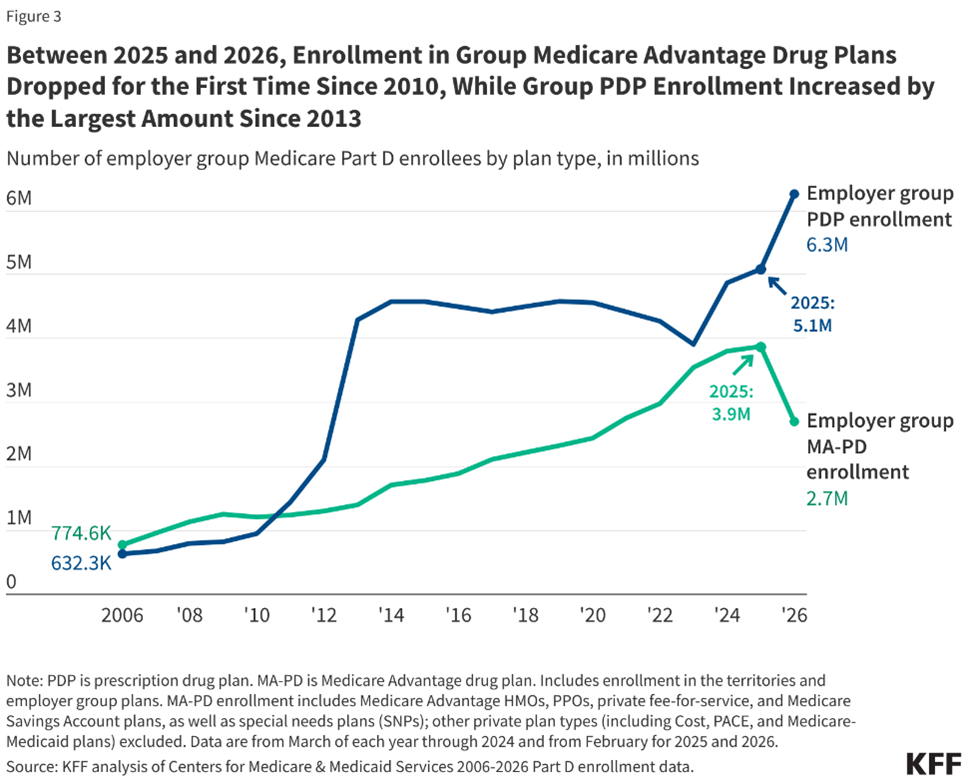
“[This popularity]…may reflect a strategy among employer/union groups of converting retiree health benefit offerings from contracts with MA-PDs that combine both medical and prescription drug benefits to contracting separately for medical benefits from MA-only plans and prescription drug benefits from stand-alone PDPs.” - KFF analysis of Centers for Medicare & Medicaid Services Part D enrollment data from February 2025 and 2026.
Several factors are driving this shift, including:
- Rising retiree drug costs
- Increasing regulatory complexity
- IRA and MFP-related changes
- Administrative burden reduction
- Demand for greater plan customization
- Long-term retiree benefit sustainability
Employers are also increasingly viewing retiree benefits as part of a broader talent retention and workforce strategy. EGWPs allow organizations to continue offering valuable retiree coverage while maintaining flexibility and greater control over plan design and cost management.
As the market evolves and regulatory demands increase, selecting an experienced PBM partner with strong operational, compliance, and clinical expertise is becoming more important than ever.